

Why microgrids? Understanding your energy future
At the Microgrid Consortium, everything we do is designed to position lead organizations for success. We transform promising opportunities into financeable, execution-ready infrastructure projects through upstream alignment and pressure-testing. Discover the power of microgrids and why they are essential for your business.
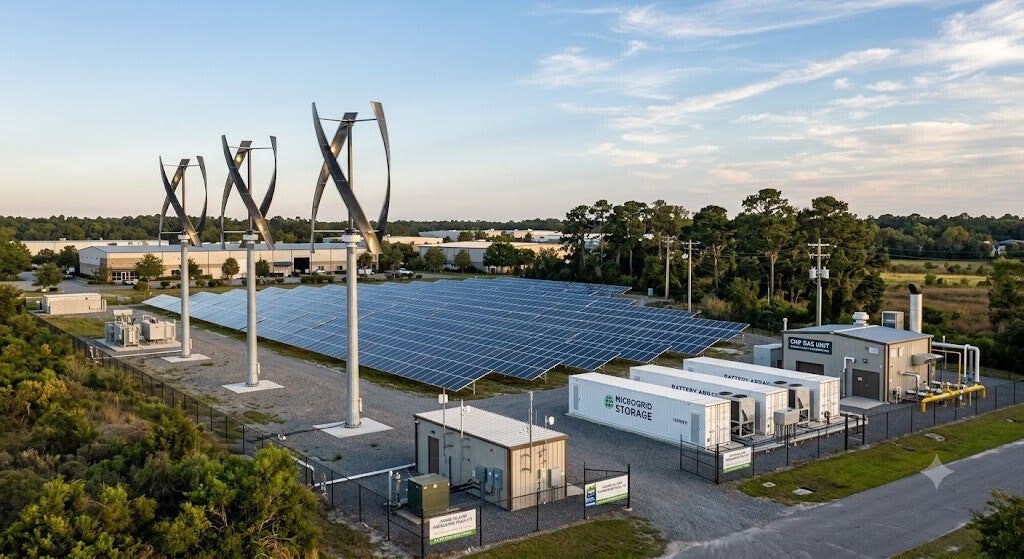
What is a microgrid and why it matters
At its core, a microgrid is a localized energy system that can manage its own generation, storage, and footprint. Unlike traditional setups that rely entirely on the main utility grid, a microgrid can operate autonomously. Commercial, industrial, and hyperscale data center operators are increasingly cutting the cord—or at least creating a safety net.
A microgrid is a self-contained power grid with three defining characteristics:
- Local Generation: It produces its own power on-site using a mix of assets (e.g., solar arrays, wind turbines, fuel cells, or backup generators).
- Energy Storage: It utilizes battery energy storage systems (BESS) to capture excess power and deploy it when needed.
- The Smart Controller (The "Brain"): Software that orchestrates the system, deciding when to draw power from the main grid, when to use stored energy, and when to "island."
The "island" mode is the defining superpower of a microgrid, allowing it to disconnect from the main grid and operate independently when necessary.

Key advantages for your business
Here is why commercial & industrial (C&I) companies and hyperscalers (large data centers) choose microgrids:
- Zero Downtime (Resilience): If the main grid crashes, a microgrid instantly switches to "island mode," keeping operations online. For data centers and factories, a few minutes of blackout can cost millions.
- Grid Bottlenecks (Speed to Market): The traditional utility grid is severely congested. Hyperscalers and manufacturers face 3–5 year delays just to get a power hookup. Microgrids let them generate their own primary power and spin up facilities immediately.
- Hitting Net-Zero Goals: They allow large enterprises to integrate massive, on-site renewables and store that clean energy to run operations 24/7, bypassing fossil-fuel-heavy utility grids.
- Cost Management: When utility rates spike during peak hours, the smart controller switches the facility to its own stored battery power (peak shaving) or sells excess energy back to the grid for profit (demand response).

Addressing common concerns about microgrids
"The upfront cost is way too high."
The Reality: You don’t have to buy it. The industry now relies heavily on Microgrid-as-a-Service (MaaS). A third-party energy developer finances, builds, and maintains the system. You pay zero upfront capital and simply buy the power through a predictable monthly agreement, turning a massive capital expense into a regular utility bill.
"What if the equipment breaks and leaves us stranded?"
The Reality: Microgrids are built with ultimate redundancy. They don't permanently cut ties with the main utility; they stay connected. If an on-site generator or battery fails, the system instantly and seamlessly switches back to drawing power from the traditional grid.
"It’s too complicated to operate without an engineering team."
The Reality: The system runs itself. Modern microgrids are managed by AI-driven controllers that handle everything autonomously—predicting weather for solar, tracking utility price spikes, and switching power sources in real time.